An SMM reseller business is about as simple as an online business gets on paper. You buy social media services at wholesale prices from a panel and sell them to clients at a markup. No stock, no warehouse, no shipping.
In practice, the people who make it work treat it like a real service business: they know their unit costs, they price for refills and refunds, and they choose suppliers that don't disappear mid-order. The people who struggle usually skipped the math.
This guide walks through the three ways to run a reseller operation, a worked margin example using real wholesale prices, how API automation works, and the costs that quietly eat profit.
- A reliable wholesale panel with an API, refill support, and stable pricing.
- A niche or channel to sell through: local businesses, creators in one platform, agencies, or your own panel site.
- A pricing sheet that covers wholesale cost, payment fees, refill risk and your time.
- Clear terms on delivery speed, refills and refunds, written before your first sale.
Three ways to run an SMM reseller business
| Model | How it works | Best for | Main drawback |
|---|---|---|---|
| Manual reselling | Clients message you, you place orders on the panel by hand. | Starting out, local clients, testing demand | Doesn't scale; every order costs your time |
| Your own panel via API | Your website takes orders and forwards them to a wholesale panel automatically. | Steady volume, international clients | Needs a site, payments and support |
| Child panel | A branded storefront supplied and hosted by a parent provider. | Quick launch without building software | Locked to one supplier's catalogue and pricing |
Most successful resellers start manually, learn what sells, then move to an API-connected panel once order volume makes manual work painful. Starting with a full website before you have a single client is the classic way to spend money learning nothing.
The margin math, with real wholesale prices
Here are starting prices per 1,000 from our own service list, for some of the services resellers sell most:
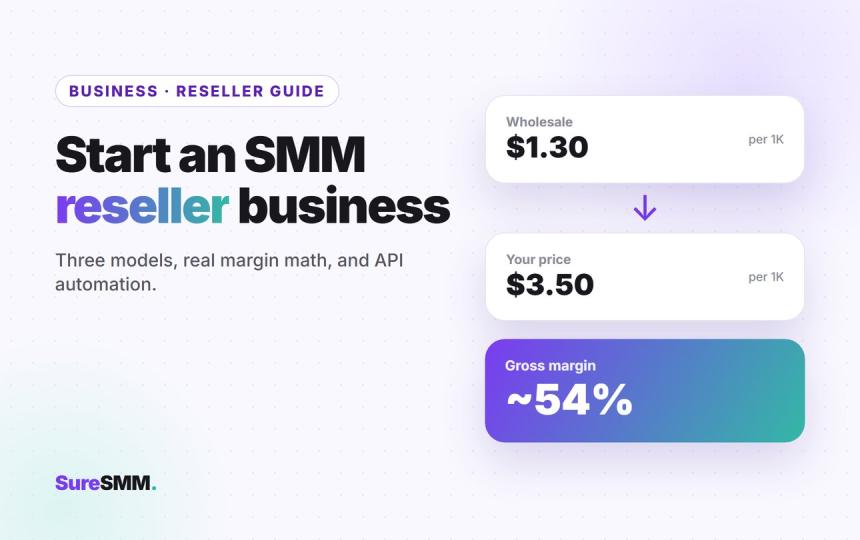
Now a worked example. Say a client wants 5,000 Instagram followers with a refill guarantee, and you decide to sell them at $3.50 per 1,000. These are illustrative numbers; your selling price depends on your market.
| Line | Amount |
|---|---|
| Revenue: 5 × $3.50 | $17.50 |
| Wholesale cost: 5 × $1.30 | − $6.50 |
| Payment fees (assume 4%) | − $0.70 |
| Risk buffer for failed or partial orders (assume 5%) | − $0.88 |
| Gross profit | $9.42 (about 54%) |
That looks healthy, but notice what happens at the cheap end. If you sell no-refill followers bought at $0.24 and they drop, your client comes back angry and you have no refill to fall back on. You either refund or buy again out of your margin. Cheap services have cheap costs, but expensive support.
How API automation works
Once you have regular orders, an API connection means orders flow from your site to the wholesale panel without you touching them. Most panels use the same request style. On SureSMM, every call is a POST to https://suresmm.com/api/v1 with your API key and an action, and the response comes back as JSON. The rate limit is 120 requests a minute.
| Action | What it does | Key parameters |
|---|---|---|
| services | Full catalogue with live rates, min/max, refill and drip-feed support | key |
| add | Places an order and returns an order ID | service, link, quantity (runs and interval for drip-feed) |
| status | Status, start count and remaining quantity | order |
| refill / refill_status | Requests a refill and tracks it | order / refill |
| balance | Your current balance and currency | key |
A typical automated flow looks like this:
Full request and response examples live in our API documentation.
Choosing a wholesale panel
Your supplier is your product. Clients never see it, but they feel every outage. Before you commit, test with small orders and check:
- Stability: does it go down, or change prices without notice? Price swings after you've quoted clients are one of the most common margin killers resellers complain about.
- Refill support: are refills automated through the API, or a support ticket every time?
- Honest service descriptions: clear speed, start time, drop expectations and refill windows in every listing.
- Drip-feed support: gradual delivery looks more natural and keeps clients happier.
- Payment methods: can you top up the way you get paid, so you're not converting currencies twice?
Mistakes that sink new resellers
- Competing only on price. There's always someone cheaper. Compete on reliability and response time instead.
- Promising what the service can't deliver. Never sell "100% real, never drops" unless the listing actually says so. It comes back to you.
- Ignoring platform rules. Social networks prohibit artificial engagement and run regular cleanups. Be upfront with clients that drops can happen and what your refill policy covers.
- No written terms. Delivery times, refill windows and refund rules should be on your site before the first order.
- Not tracking start counts. Without them you can't prove delivery or calculate a refill. Log them automatically.
If you're still getting familiar with how orders move from click to delivery, read how SMM panels work first. It covers the supply chain you'll be building on.
Frequently asked questions
How much money do you need to start an SMM reseller business?
Very little for the manual model: enough balance to cover your first few orders, often under $20. An API-connected website adds hosting, a domain, a payment gateway and development time.
What is the difference between a child panel and a reseller panel?
A child panel is a branded storefront run on a parent provider's infrastructure and catalogue. A reseller panel usually means your own site connected to one or more wholesale panels by API, which gives you more control over suppliers and pricing.
What profit margin can an SMM reseller make?
There's no reliable industry average. It depends on your wholesale cost, selling price, payment fees and how many orders need refills or refunds. Work out your margin per service using real wholesale prices before you set retail prices.
Do I need to know how to code?
Not for manual reselling or a child panel. For your own API-connected panel you'll either use ready-made panel software that supports standard SMM APIs or hire a developer.
Is reselling SMM services legal?
Reselling digital services is generally legal, but social platforms' terms prohibit artificial engagement, so accounts can be affected by cleanups. Be transparent with clients and check the rules where you operate.
Sources and further reading
- SureSMM: API documentation and live service rates
- IPS News: Best SMM child panel for resellers: how to start your own in 2026
- IPS News: Is an SMM panel profitable?