If your channel is sitting somewhere between 2,000 and 4,000 watch hours right now, the next three months matter more than any other stretch this year.
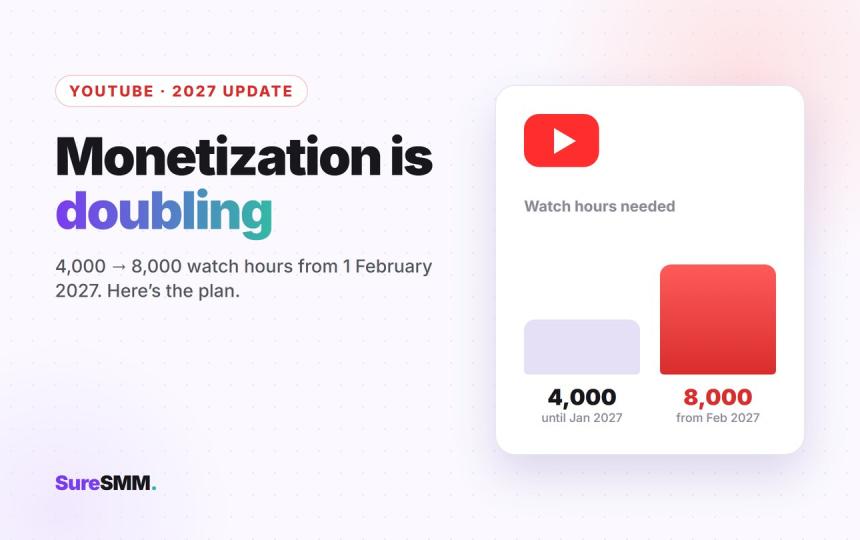
In August 2026 YouTube announced that, from 1 February 2027, new channels applying for ad revenue will need 8,000 watch hours instead of 4,000, or 20 million Shorts views instead of 10 million. The 1,000-subscriber minimum stays where it is. In plain terms, the most common route into monetization is about to get twice as long.
This guide covers what changes, what doesn't, the math behind 8,000 hours, and a realistic plan for the weeks you have left under the current rules.
- Until 31 January 2027: 1,000 subscribers + 4,000 public watch hours (last 12 months) or 10M Shorts views (last 90 days).
- From 1 February 2027: 1,000 subscribers + 8,000 watch hours (last 365 days) or 20M Shorts views (last 90 days).
- Already monetized? Reports of the announcement say current partners keep their status, but you still need to accept the updated terms in YouTube Studio before the deadline.
- Close to 4,000 hours? Push now. Every hour you add before February counts against half the target it will be measured against later.
What exactly is changing on 1 February 2027
YouTube runs two levels of the Partner Program. The lower level unlocks fan funding (memberships, Super Chat, Super Thanks) and Shopping. The full level unlocks ad revenue and YouTube Premium revenue, which is where most creators actually make money. The announced change hits the full level.
| Requirement | Today (to 31 Jan 2027) | From 1 Feb 2027 |
|---|---|---|
| Subscribers | 1,000 | 1,000 (unchanged) |
| Long-form path | 4,000 public watch hours in 12 months | 8,000 qualified watch hours in 365 days |
| Shorts path | 10M valid Shorts views in 90 days | 20M qualified Shorts views in 90 days |
| Lower tier (fan funding, Shopping) | 500 subs, 3 uploads in 90 days, 3,000 hours or 3M Shorts views | No change reported so far |
You only need one of the two performance paths, not both. Shorts watch time does not count toward the long-form hours, and long-form hours don't help the Shorts number. Choose the path that matches what your channel already does well.
Why YouTube is raising the bar
YouTube hasn't framed this as a punishment for anyone, and there's no single official reason beyond quality and sustainability. But the pattern is easy to read. The program has grown enormously since 2018, when the current 4,000-hour rule was introduced. Short-form content has made it far easier to rack up views without building the kind of audience advertisers pay a premium for. A higher threshold filters for channels that hold attention over time, which is exactly the inventory that sells best.
For creators, the takeaway is less about why and more about how: watch time is now the currency, and long sessions beat lots of short ones.
The math: what 8,000 hours actually takes
8,000 hours is 480,000 minutes. How many views that requires depends almost entirely on your average view duration, which is the number to watch in YouTube Analytics. Here is how many views a year you'd need at different average watch lengths:
That chart explains most of what follows. A channel with a two-minute average needs ten times the views of a channel whose viewers stay for twenty. Doubling your average view duration does more for monetization than doubling your upload count, and it's usually cheaper to do.
Daily, the numbers look less scary. 120,000 views a year is about 330 views a day at a four-minute average. 48,000 views a year at ten minutes is roughly 130 a day.
What counts, and what quietly doesn't
A lot of creators feel close to the line, then find out their Studio number is lower than expected. Usually it's one of these:
- Only public videos count. Unlisted, private and deleted videos don't contribute. If you delete an old video, its hours leave with it.
- It's a rolling window. Hours from thirteen months ago fall off every day. A channel that peaked last summer can lose ground while standing still.
- Shorts are separate. Since 31 March 2025 the public Shorts counter registers every play and replay, which makes Shorts numbers look bigger. YouTube judges monetization on its own validated figures, so the public counter overstates progress.
- Invalid traffic is removed. YouTube filters views and watch time it considers artificial. That's why a sudden jump can shrink a few days later.
A 90-day plan to beat the February deadline
If you're within reach of 4,000 hours, the goal is simple: get approved under the current rules. Here's the order we'd work in.
Long-form or Shorts: which path should you take?
For most growing channels, long-form remains the realistic path. 20 million Shorts views in 90 days works out to about 222,000 views every single day. Channels that hit that are usually already big. The Shorts path suits creators who have a proven viral format and a big backlog. For everyone else, Shorts are best used as a funnel: short clips that send viewers to your long videos, where the watch hours are actually earned.
Where promotion helps, and where it doesn't
We run an SMM panel, so we'll be honest about what it is good for here. Paid promotion can solve a cold-start problem: a premiere nobody shows up to, or a live stream that sits at three viewers and never gets recommended. A small initial push can get real people into the chat, and real people are what make YouTube's recommendation system take notice.
What promotion can't do is replace retention. If a video loses half its audience in the first minute, no amount of traffic fixes that, and YouTube's review team will see an odd traffic pattern long before you see a payout. If you're curious how panel services actually deliver, our guide on how SMM panels work walks through the full order lifecycle.
Frequently asked questions
Does the 8,000-hour rule apply to channels already in YPP?
According to coverage of YouTube's announcement, no. Existing partners keep their eligibility but need to accept the updated terms in Studio before 31 January 2027. Check the Earn tab for the current wording, since YouTube's own notice is the final word.
If I apply in January, will I be reviewed under the old rules?
YouTube hasn't spelled out how applications pending on 1 February will be treated. The safest assumption is that you want approval, not just an application, before the switch. That's another reason to apply the day you qualify.
Do live stream hours count?
Yes, as long as the stream replay stays public on your channel. If you delete or unlist the replay, those hours disappear from the total.
Do views from Shorts count toward watch hours?
No. Shorts views count only toward the separate Shorts path. Long-form and live content are the only sources of watch hours for the long-form requirement.
Is the lower tier (500 subscribers) changing too?
Nothing announced so far points to a change in the fan-funding tier. It still requires 500 subscribers, three public uploads in 90 days, and either 3,000 watch hours or 3 million Shorts views.
Sources and further reading