Everyone in social media marketing repeats the same idea: people like things that other people already like. It's why restaurants seat early diners by the window, and why a post with 2,000 likes feels more trustworthy than the same post with 12.
But how strong is that effect really? Does it keep growing with every extra like, or does it level off? And does a like actually make someone click, buy or follow, or just tap the heart?
Researchers have tested this with real platforms and real users. The findings are more useful, and more surprising, than the usual "social proof matters" line. Here's what the evidence says.
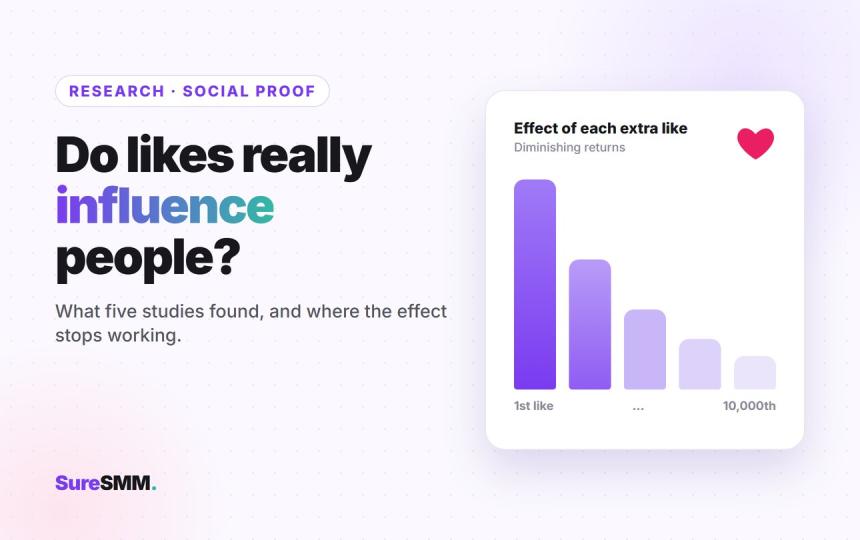
- The first signal matters most. Going from zero to some engagement has a bigger effect than going from a lot to even more.
- Likes drive likes more than clicks. Visible approval makes people engage publicly, but it moves private decisions like clicking far less.
- Unknown brands gain the most. When people have little else to judge you by, social signals carry more weight.
- Too few can look like none. A tiny number of likes may do nothing at all.
What social proof is (and why it works)
Psychologist Robert Cialdini popularised the term in his 1984 book Influence. The principle is simple: when we're unsure what to do, we look at what other people are doing and assume they know something we don't.
Researchers usually split it into two forces:
- Informational influence: "lots of people liked this, so it's probably good." Other people's choices act as evidence.
- Normative influence: "everyone else is engaging, so I will too." We conform to fit in, even when we're not convinced.
Both matter on social media, but as you'll see below, they affect different behaviours.
Study 1: one upvote shifted final ratings by 25%
In 2013, Lev Muchnik, Sinan Aral and Sean Taylor published a randomized experiment in Science. Working with a social news site, they gave thousands of comments a single random upvote, a single random downvote, or nothing, then watched what real users did next.
One early upvote created a lasting herd effect. The negative manipulation didn't stick in the same way, because users tended to correct downvoted comments. Positive signals snowball. Negative ones get pushed back.
Study 2: popularity made success both bigger and less predictable
Matthew Salganik, Peter Dodds and Duncan Watts built an online music market (published in Science in 2006) with more than 14,000 participants. Some groups could see how many times each song had been downloaded. Others couldn't.
When download counts were visible, popular songs became far more popular, and unpopular ones fell further behind. Results also became much less predictable: the same song could be a hit in one group and ignored in another, depending on early luck. Quality still mattered (the best songs rarely did worst), but early visible popularity decided a lot of the outcome.
Study 3: the first like is worth the most, and likes don't equal clicks
The most directly relevant research for marketers comes from a 2025 field experiment in the Journal of Marketing by Song Lin (Hong Kong University of Science and Technology) and Shan Huang (University of Hong Kong). They studied how like counts on social ads on Instagram and Facebook affected what people did.
Their main findings:
- The first like is a critical cue. Having any likes at all boosted both likes and clicks noticeably.
- More likes raised liking, but not clicking. In Lin's words, additional likes enhance the liking rate "without significantly increasing clicks." Click-through plateaued.
- Brand familiarity changed everything. Extra likes helped lesser-known brands, but added little for well-known ones, since people already had other ways to judge them.
That fits the two-force model neatly. Liking is public, so normative pressure works well. Clicking is private and depends on whether the ad seems relevant and credible, and that informational value weakens once there are already plenty of likes.
Study 4: a handful of likes can look like none
Research by Bhattacharyya and Bose in Decision Support Systems (2020) found that a low volume of likes produced behaviour similar to having no likes at all. Social proof only became effective once the number was substantially high.
Put that next to the Lin and Huang result and you get a curve with a threshold at the bottom: some minimum signal before people notice, a strong effect once they do, then diminishing returns.
Study 5: comments only help when they're useful
A 2018 study in Frontiers in Communication looked at reactions to posts about organic food. Social proof did influence attitudes and willingness to pay, but only when people found the comments useful. Empty praise didn't carry the same weight as comments that said something.
That's a quiet but important point: a wall of generic "nice post 🔥" comments isn't the same as social proof. Comments that answer questions, share experiences or add detail do the persuading.
What this means for growing an account
Taken together, the research points to a fairly clear playbook:
Where SMM panels fit, honestly
This research is the reason SMM panels exist. Businesses use them to get past the "zero" problem: a new product page, a brand-new profile, or a launch post that would otherwise sit with no visible engagement. You can read more about how that works in our guide to what an SMM panel is.
But the same research sets clear limits. Bought engagement can provide the first signal, and it can make an unknown brand look less risky. It can't make an irrelevant offer relevant, and past a modest threshold it won't add many clicks. Platforms also remove inauthentic engagement in cleanups, so it's a starting push, not a foundation. The accounts that grow long term pair an early boost with content that real people actually want to engage with.
Frequently asked questions
Do more likes lead to more sales?
Not directly. A 2025 field experiment found that additional likes on social ads increased further liking but did not significantly increase clicks. The first likes matter most, especially for lesser-known brands.
What is social proof in social media marketing?
It's the tendency to treat other people's engagement (likes, comments, shares, follower counts) as evidence that something is worth attention. It works through both informational and normative influence.
Is there a minimum number of likes before social proof works?
Research suggests very low numbers can have about the same effect as none. There's no universal threshold, since it depends on platform and audience, but a handful of likes is unlikely to persuade anyone.
Do negative signals work the same way?
Not according to the 2013 Science experiment. One random upvote created lasting positive herding, while one random downvote was largely corrected by later users.
Does social proof work for big brands?
Less so. People already have plenty of information about well-known brands, so extra likes add little. Social proof does the most for brands people haven't heard of.
Sources and further reading
- American Marketing Association: Do more likes lead to more clicks? (Journal of Marketing, Lin and Huang, 2025), DOI 10.1177/00222429241307608
- Muchnik, Aral and Taylor (2013). Social influence bias: a randomized experiment. Science 341(6146).
- Salganik, Dodds and Watts (2006). Experimental study of inequality and unpredictability in an artificial cultural market. Science 311(5762).
- Frontiers in Communication (2018): social proof, comments and organic food perceptions
- HKUST Business Insight: Do more likes lead to more clicks?